VA Individual Unemployability in 2026
There is a gap in the VA rating system that millions of veterans fall into.
A veteran with a combined rating of 80% is clearly significantly disabled. But 80% pays $2,102.15 per month. 100% pays $3,938.58 per month. The gap is $1,836.43 per month. $22,037 per year. Tax-free.
Many veterans in that gap cannot work. Their service-connected conditions prevent them from holding a job. But they cannot reach 100% through the combined rating formula without more conditions or higher ratings.
TDIU is the bridge across that gap.
Total Disability Individual Unemployability, called TDIU or IU, pays veterans at the 100% compensation rate regardless of their underlying combined rating. The only requirements are meeting percentage thresholds and demonstrating that service-connected conditions prevent substantially gainful employment.
In 2026, 1,547,842 veterans were rated at 100% disabled. Many of them are there through TDIU, not through a 100% schedular rating.
What TDIU Is and Is Not
TDIU is a pay status, not a rating change. Your underlying service-connected conditions and their percentages do not change. Your combined rating does not change. What changes is the compensation level. You receive the 100% pay rate.
TDIU is awarded under 38 CFR 4.16. It recognizes that the VA's rating formula does not fully capture the economic impact of disability. A veteran at 80% combined may be just as unable to earn a living as a veteran rated 100% schedular. TDIU exists to compensate for that reality.
Who Qualifies: The Two Pathways
38 CFR 4.16(a) Schedular TDIU
This is the standard pathway. You must meet one of two percentage thresholds and demonstrate that service-connected conditions prevent substantially gainful employment.
Threshold one: A single service-connected condition rated at 60% or higher.
Threshold two: A combined rating of 70% or higher, with at least one individual condition rated at 40% or higher.
These thresholds apply only to service-connected conditions. Non-service-connected conditions, age, and non-SC-related health issues do not count toward the percentage requirements. But they also do not disqualify you. A 68-year-old veteran with a 70% combined rating and age-related health problems is not disqualified from TDIU because of age. The question is whether service-connected conditions alone prevent employment.
38 CFR 4.16(b) Extraschedular TDIU
This pathway is for veterans who do not meet the percentage thresholds but whose service-connected conditions still prevent substantially gainful employment. These cases are referred to the VA's Director of Compensation Service rather than decided at the regional office level.
The evidence standard is higher. The veteran must demonstrate that their specific situation is exceptional and that the rating schedule does not adequately capture the occupational impact of their service-connected conditions.
Veterans who narrowly miss the 4.16(a) thresholds but clearly cannot work due to their service-connected conditions should pursue 4.16(b) simultaneously.
What "Substantially Gainful Employment" Means
This phrase is the center of every TDIU claim. It means work that provides income above the federal poverty threshold, approximately $15,650 per year for a single person in 2026.
What does not count as substantially gainful employment:
Marginal employment. Work that produces income below the poverty threshold is not substantially gainful. A veteran working a few hours a week at a wage that does not approach the poverty level may still qualify for TDIU.
Sheltered employment. Work performed in a protected environment where productivity standards are adjusted for the veteran's disability. VA-supported employment programs and similar settings qualify as sheltered employment.
What does count:
Regular full or part-time employment with income consistently above the poverty threshold disqualifies a veteran from TDIU. If you begin that kind of employment after TDIU is awarded, you must report it to the VA.
What does not affect TDIU:
Unearned income. Investment returns, rental income, retirement pensions, Social Security disability payments, and military retirement pay do not count toward the substantially gainful employment threshold. The VA's concern is with earned income from work, not passive or retirement income.
Building the Evidence
TDIU claims to live or die on evidence. Three documents carry the most weight.
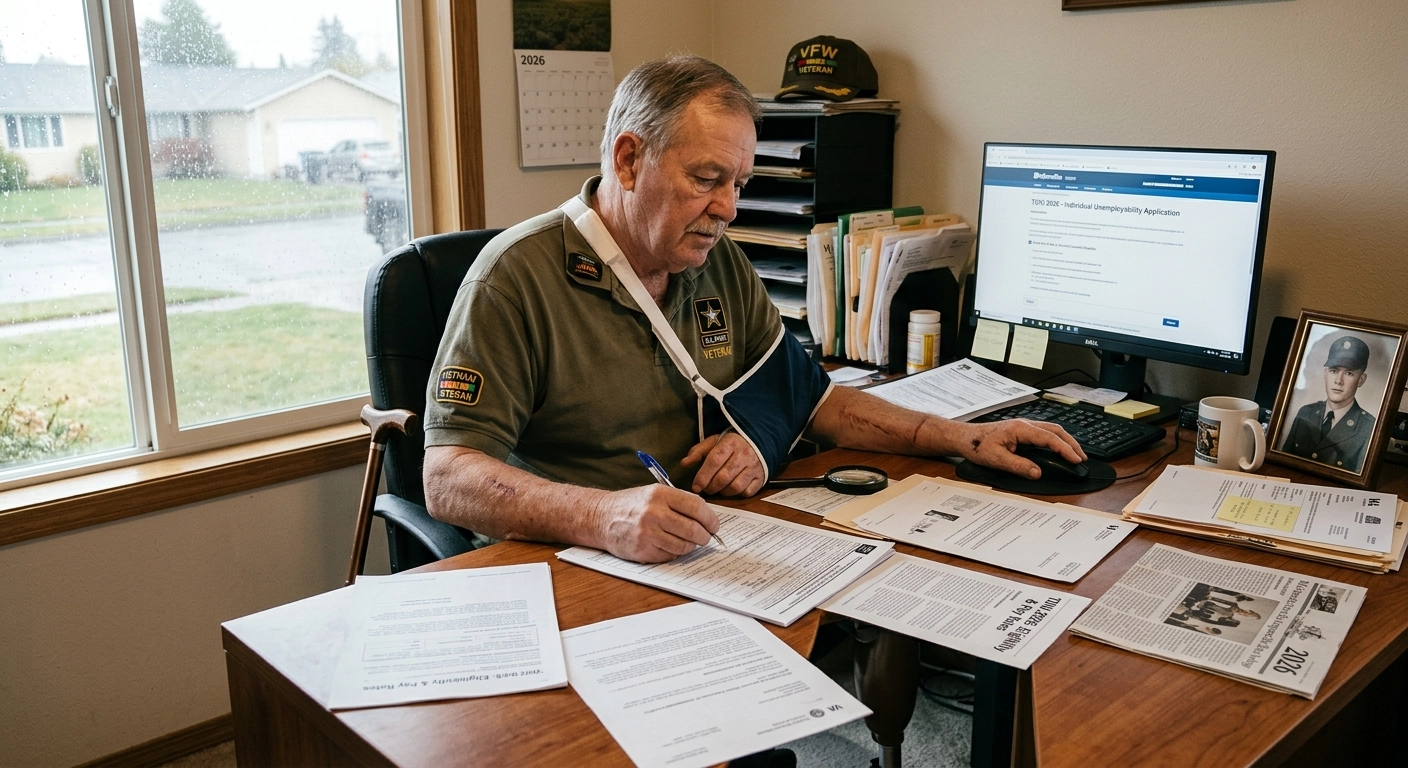
VA Form 21-8940. The primary TDIU application. It documents your work history, your last date of employment, your education and training, and your reported inability to secure or maintain employment. File this form. Every TDIU claim should include it.
Medical records documenting functional limitations. Treatment records should reflect not just diagnoses but what those diagnoses prevent you from doing. Records that document inability to sit for more than 20 minutes, inability to concentrate for sustained periods, frequent pain-related absences from work, and specific incidents where disability interfered with employment are what raters look for.
Physician statements. A written statement from a treating physician specifically addressing your ability to work is critical. The statement should connect named service-connected conditions to named functional limitations that prevent employment. General statements about disability are less persuasive than specific functional assessments.
Supporting evidence worth adding: employment records showing terminations or reduced hours connected to your conditions. Buddy statements from former supervisors or coworkers who observed the functional impact. SSDI award letters if Social Security has determined you are unable to work.
TDIU and Social Security Disability
Many veterans receiving SSDI ask whether that automatically means TDIU. It does not. The two systems use different legal standards and operate independently.
But SSDI is strong supporting evidence. The Social Security Administration determined you cannot perform substantial gainful activity. That is a finding from a federal agency that VA raters take seriously. Include your SSDI award letter and any SSA decision documents in your TDIU file.
The reverse is also true. A TDIU award does not automatically qualify you for SSDI. Apply for each separately.
After TDIU Is Awarded: Protections and Obligations
Working. If you begin substantially gainful employment after TDIU is awarded, you must report it to the VA. The VA may terminate TDIU if you consistently earn above the poverty threshold. One-time or temporary income above the threshold generally does not trigger termination.
Re-examinations. The VA may schedule future re-examinations to assess whether conditions have improved. Unless you have a Permanent and Total designation, TDIU is not necessarily permanent.
Permanent and Total. If your conditions are unlikely to improve, request P&T designation along with your TDIU claim. P&T protects against re-examination. It also opens eligibility for CHAMPVA health coverage for your dependents, Chapter 35 DEA education benefits for dependents, and commissary access.
20-year protection. Any rating continuously held for 20 or more years cannot be reduced below that level absent a finding of fraud under 38 CFR 3.951(b). Veterans who have held their combined rating for 20 years have a protected floor regardless of TDIU status.
Is TDIU the Right Path for You?
If you have a combined rating of 70% or higher with one condition at 40% or more and you cannot maintain substantially gainful employment due to your service-connected conditions, the answer is almost certainly yes.
If you are at 60% or 80% and cannot work, the answer may still be yes depending on your individual condition ratings.
A VA-accredited attorney can review your rating picture and employment history at no cost. They identify whether the evidence supports a TDIU claim and help you build the file. They are paid only if they win.
Get a free TDIU eligibility review from a VA-accredited attorney.
No upfront cost. No fee unless you win.
Frequently Asked Questions
What is the income limit to qualify for TDIU in 2026?
To qualify for TDIU, a veteran must be unable to secure or maintain substantially gainful employment. The VA defines substantially gainful employment as work that produces income above the federal poverty threshold for a single person, which is approximately $15,650 per year in 2026. Veterans who earn below that threshold through work are considered marginally employed and generally remain eligible for TDIU. Veterans who earn consistently above that threshold through earned income from regular employment are typically not eligible. Unearned income from sources such as Social Security disability benefits, retirement pensions, military retirement pay, rental income, and investments does not count against the threshold. The VA's concern is with earned income from work activity, not passive income sources.
Can I qualify for TDIU if my combined rating is less than 70%?
Possibly. Under 38 CFR 4.16(b), the extraschedular TDIU pathway, veterans who do not meet the standard percentage thresholds may still qualify if their service-connected conditions prevent substantially gainful employment and their situation is exceptional relative to what the rating schedule captures. These cases are referred to the VA's Director of Compensation Service rather than decided at the regional office level. The evidence standard is higher. Veterans must demonstrate not only that they cannot work, but also that their specific functional limitations are unusual enough that the standard rating schedule does not adequately reflect the occupational impact. Veterans who narrowly miss the 4.16(a) thresholds should always request 4.16(b) consideration in their TDIU application.
Does TDIU affect my other VA benefits?
TDIU changes your compensation level to the 100% rate but does not change your individual condition ratings. Your service-connected conditions remain rated at the same percentages. Most other VA benefits are unaffected. Veterans rated at 100%, including those on TDIU, are eligible for Priority Group 1 VA healthcare, which means no copays for VA medical care. TDIU veterans who receive a Permanent and Total designation also gain access to CHAMPVA health coverage for their dependents, Chapter 35 DEA education benefits for dependents, and commissary and exchange privileges at military installations. Veterans receiving military retirement pay may see interactions between retirement pay and VA compensation that depend on their specific situation, and should consult a VSO or attorney about concurrent receipt rules.
How long does a TDIU claim take to process?
TDIU claims are processed as part of the veteran's overall disability claim file. A standalone TDIU application using VA Form 21-8940 follows the same general timeline as a supplemental claim, approximately 61 days from receipt to decision based on current VBA averages. However, TDIU claims that require a new C&P exam to evaluate the functional impact of conditions take longer. Claims with strong existing documentation, including physician statements specifically addressing work capacity and clear employment history records, tend to process faster than those requiring additional development. Filing a Fully Developed Claim with all supporting evidence submitted upfront is the most reliable way to minimize processing time. Veterans represented by an accredited attorney or VSO from the beginning tend to have more complete files, which also supports faster processing.
What happens to my TDIU if my conditions improve?
TDIU is not automatically permanent. The VA may schedule future re-examinations to assess whether service-connected conditions have changed. If a re-examination shows material improvement in the conditions underlying the TDIU determination, the VA may propose to reduce or terminate TDIU. However, regulatory protections apply. A reduction requires a finding of improvement under ordinary conditions of life, not just improvement observed at a clinical exam. Veterans who have held their combined rating for five or more years require a showing of sustained improvement across multiple examinations before any reduction can be implemented. Veterans who obtain a Permanent and Total designation, which signals the VA has determined the conditions are unlikely to improve, are protected from future re-examination entirely.
Can I work at all while receiving TDIU?
Veterans receiving TDIU can engage in some forms of work without losing the benefit. Marginal employment, which produces income below the federal poverty threshold of approximately $15,650 per year in 2026, does not constitute substantially gainful employment and generally does not disqualify a veteran from TDIU. Work performed in a sheltered or protected environment where productivity standards are specifically adjusted for the veteran's disability is also not considered substantially gainful. Veterans who want to attempt work while receiving TDIU should do so cautiously and should consult a VA-accredited attorney before accepting employment that could approach the threshold. Any work that produces income consistently above the poverty threshold should be reported to the VA, as it may result in TDIU termination.