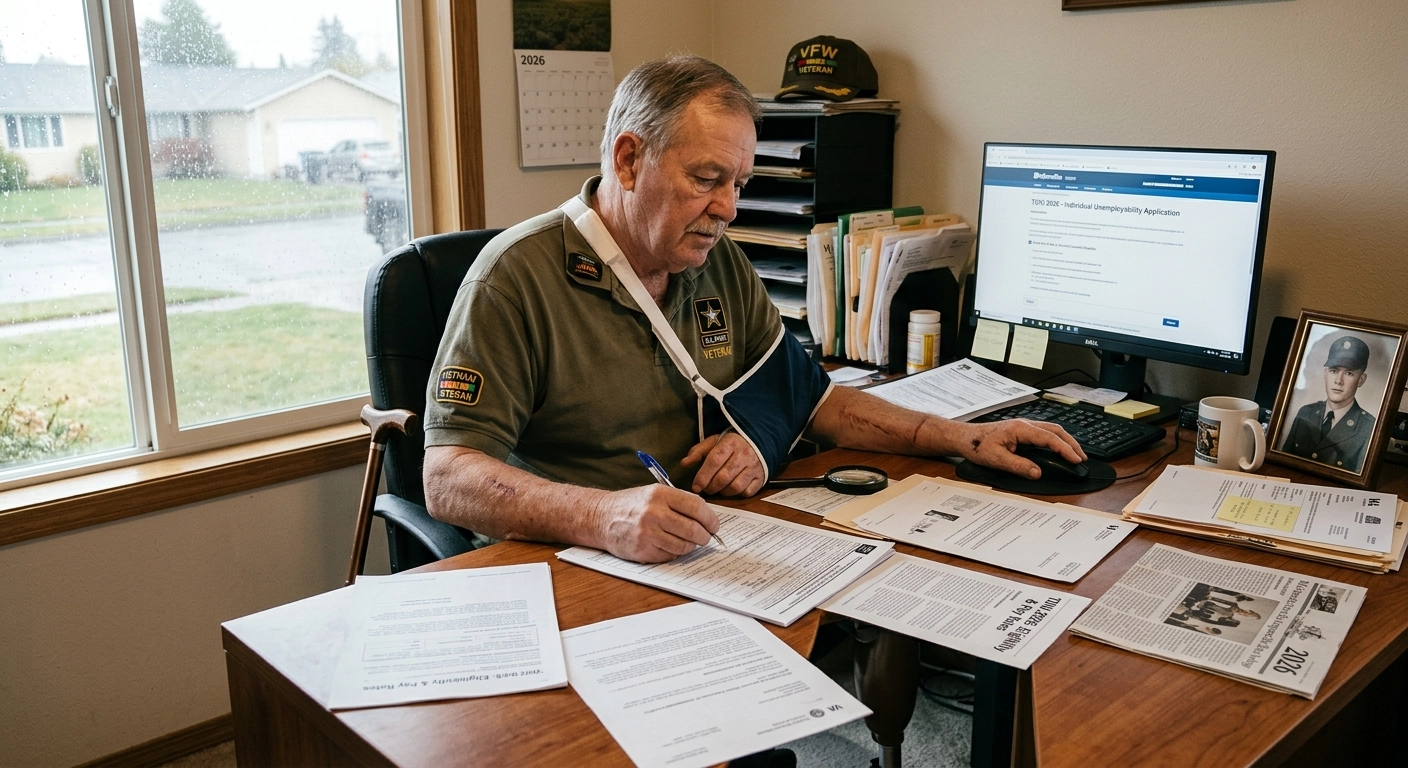

How VA Disability Ratings Are Calculated
About 17.3 million veterans are alive in the United States right now. Only about 6 million receive VA disability compensation. That means roughly 12 million veterans are getting nothing.
That number is not all explained by eligibility. Many veterans have legitimate service-connected conditions and have never filed. Many filed and accepted a rating that was too low. Many do not understand how the process works well enough to advocate for themselves.
This post explains exactly how VA disability ratings are calculated from start to finish. No jargon. Just the process.
Step 1: Filing the Claim
Everything starts with the claim. The VA cannot rate a condition it does not know about.
You file using VA Form 21-526EZ, the Application for Disability Compensation and Related Compensation Benefits. You can file online at VA.gov, by mail, or in person at a regional VA office.
When you file, list every condition you believe is connected to your military service. Everyone. The VA only rates conditions that are claimed. If you leave a condition off the form and it is not otherwise in your record, the VA will not rate it.
The date you file matters. The VA generally pays back pay from your effective date, which is usually the date the VA receives your claim. Filing sooner means an earlier effective date and potentially more back pay.
Step 2: VA Gathers Evidence
After you file, the VA is required to assist in developing your claim. This is called the duty to assist.
The VA will request your service treatment records from the National Personnel Records Center. It will request your VA medical records. It may request records from private treatment providers if you identify them.
This step takes time. The average VA disability claim takes about 85 days to process. Claims with multiple conditions, missing records, or complex diagnoses can take longer. A Fully Developed Claim, where you submit all evidence yourself upfront, can reduce processing time to approximately 30 days.
Step 3: The Compensation and Pension Exam
For most claims, the VA will schedule a Compensation and Pension exam, also called a C&P exam. This is a medical examination specifically for the purpose of rating your disability.
C&P exams are conducted by VA-contracted physicians, nurse practitioners, or physician assistants. The examiner reviews your records and examines you. They then complete a Disability Benefits Questionnaire that becomes part of your claim file.
The C&P exam is where many veterans unknowingly hurt their claim. Two common mistakes:
Minimizing symptoms. Military culture encourages toughness. Veterans often downplay pain and limitations at the exam. The examiner can only rate what is documented. If you say your back "gets a little sore sometimes," that is what gets recorded.
Pushing through pain. For musculoskeletal conditions, examiners measure your range of motion. If you push past the pain to show how tough you are, the measurement reflects your maximum mechanical range, not your functional range. The VA rating formula is based on where you stop, not where you could go if you ignored the pain.
Prepare for your C&P exam. Know your symptoms. Report your worst days, not your best. Describe what you cannot do, not just what hurts.
Step 4: The Rating Decision
A VA rater reviews all the evidence and issues a rating decision. The decision does three things.
It establishes whether a service connection exists for each condition. The rater determines whether there is a diagnosis, a service event, and a medical nexus connecting the two.
It assigns a disability percentage to each service-connected condition. Percentages are assigned based on the VA Schedule for Rating Disabilities at 38 CFR Part 4. Each diagnostic code has specific criteria.
It calculates the combined rating using the whole person method defined in 38 CFR 4.25. This formula does not add percentages together. It applies each rating to the remaining efficiency, highest to lowest, then rounds the result to the nearest 10%.
Step 5: The Decision Letter
You receive a rating decision letter explaining what was service-connected, what was denied, the percentage assigned for each condition, and the calculated combined rating.
Read this letter carefully. Check every condition you claimed. Verify whether the bilateral factor was applied for paired-extremity conditions. Compare the percentage assigned against the criteria in the diagnostic code to confirm the rating is accurate.
If anything is wrong, you have options. A supplemental claim allows you to add new evidence. A higher-level review puts a senior rater on your case. A Board of Veterans Appeals appeal takes the case to a judge.
You have one year from the date of the rating decision to appeal without losing your effective date.
What Affects Your Rating
Five things determine how high your rating is.
Medical evidence. Treatment records, test results, and physician opinions are the backbone of any claim. Thin records produce low ratings.
C&P exam performance. The examiner's report is often the most influential document in the file. How you describe your symptoms at that exam matters.
Nexus opinions. A physician's written opinion connecting your condition to your service can make or break a claim. Private nexus letters from treating physicians often carry significant weight.
Secondary conditions. Every condition you have that is caused or worsened by a service-connected disability is separately ratable. Many veterans file only the primary condition and miss the secondary chain.
The diagnostic code. The code matters because it determines which criteria apply. A knee condition rated under the instability code and the flexion limitation code gets two separate ratings. The same condition rated under only one code leaves money unclaimed.
Get a Free Review of Your Current Rating
If you have an existing rating, a free review by a VA-accredited attorney can identify whether the rating is accurate, whether secondary conditions have been missed, and whether an increase is supported by evidence.
Get a free disability rating review from a VA-accredited attorney.
No upfront cost. No fee unless you win.
Frequently Asked Questions
What does the VA look at when calculating a disability rating?
When calculating a VA disability rating, the VA examines three core elements for each claimed condition. First, a current diagnosis of the condition must exist, documented in medical records. Second, an in-service event, injury, or exposure must have occurred that caused or contributed to the condition. Third, a medical nexus must connect the current diagnosis to the in-service event. After service connection is established, the VA assigns a percentage based on the criteria in the Schedule for Rating Disabilities at 38 CFR Part 4. The percentage reflects the severity of functional impairment, not the severity of the original injury. For musculoskeletal conditions, measurements taken at the Compensation and Pension exam are the primary driver of the rating. For mental health conditions, occupational and social impairment is the primary driver.
How long does it take the VA to process a disability claim in 2026?
The average VA disability claim takes approximately 85 days to process from the date of filing to the rating decision, based on the most recent Veterans Benefits Administration data. Processing times vary significantly based on the complexity of the claim, the number of conditions claimed, the availability of service records, and the workload at the regional office handling the claim. Veterans who file a Fully Developed Claim and submit all supporting evidence at the time of filing may receive a decision in as few as 30 days. Supplemental claims for existing service-connected conditions take approximately 61 days on average. Claims involving rare conditions, conflicting medical opinions, or incomplete records take longer. Filing all evidence upfront is the single most reliable way to reduce processing time.
What is a Compensation and Pension exam and do I have to attend?
A Compensation and Pension exam, commonly called a C&P exam, is a medical examination ordered by the VA to evaluate a veteran's claimed disability for rating purposes. It is conducted by a VA-contracted healthcare provider and results in a Disability Benefits Questionnaire that becomes part of the veteran's claims file. The examiner does not treat the veteran. Their purpose is to document findings that the VA rater will use to assign a disability percentage. Attending the C&P exam is critical. Failing to appear for a scheduled exam without good cause can result in a claim being denied due to insufficient medical evidence. Veterans can reschedule with advance notice if the date does not work. The exam is free of charge to the veteran.
What happens if I disagree with my VA disability rating decision?
If you disagree with a VA disability rating decision, you have three options under the Appeals Modernization Act. A supplemental claim allows you to submit new and relevant evidence not previously considered, and the VA is required to review the claim with fresh eyes. A higher-level review assigns a senior VA rater to review the existing record without new evidence, looking for errors in the original decision. A Board of Veterans Appeals appeal takes the case to a Veterans Law Judge and allows you to request a hearing. All three options must be initiated within one year of the date of the rating decision to preserve your original effective date. Veterans who miss the one-year window can still appeal but may lose back pay from the original effective date.
Can I claim conditions that developed after leaving military service?
Yes, in many situations. A condition does not have to have developed during active service to be service-connected. It only needs to be connected to something that happened during service. Conditions that result from a service-connected injury can be rated as secondary conditions under 38 CFR 3.310. Conditions that worsen over time from a service-related injury can also be rated. Additionally, some conditions qualify for presumptive service connection under 38 CFR 3.309, meaning the VA presumes they are service-related for veterans who served in specific locations or were exposed to specific hazards. Agent Orange presumptives, PACT Act toxic exposure conditions, and Gulf War presumptives are examples. A VA-accredited attorney or VSO can help identify whether a post-service condition has a pathway to service connection.